A drive enclosure from identical printed boxes
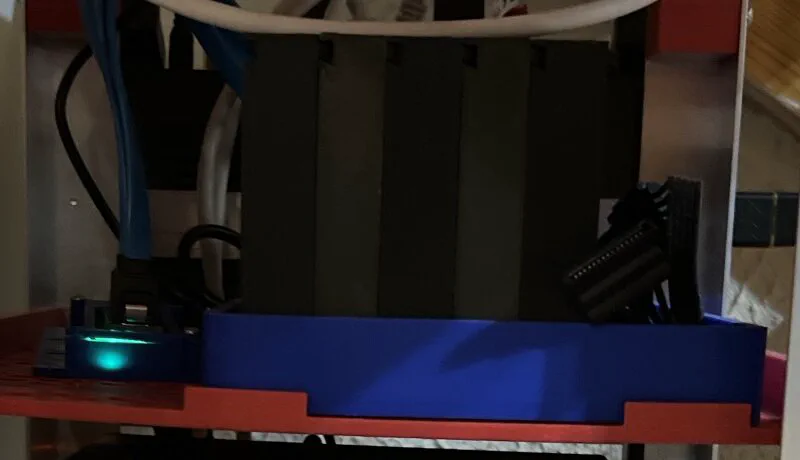
I wanted a home for a bank of 2.5" drives that fits the rack, so I made one out of parts I could print. Every module is an identical box, and the boxes lock together.
The idea
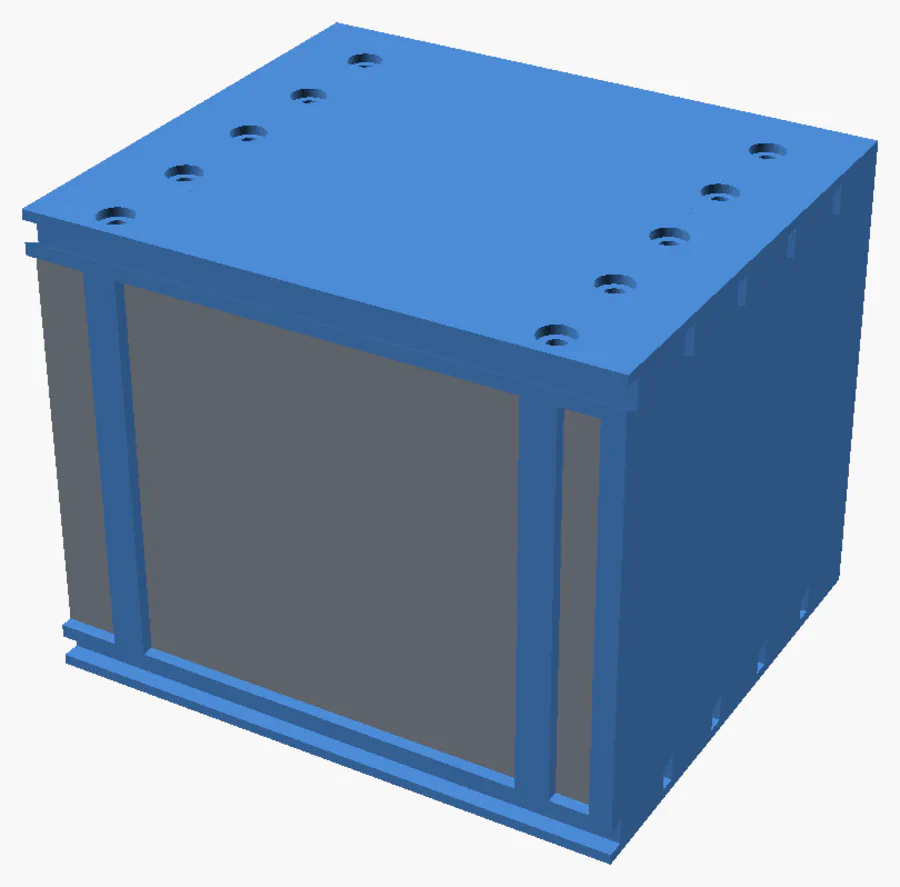
Drives stand on edge, like books on a shelf. Each box is a floor plate, a top plate, a front wall and four corner posts. Both big faces of the drive stay open, so air goes straight through. The boxes join along the edges of their plates with a half-dovetail (male on one face, female on the other, with a 45° lead-in), so there is no separate rail and no monolithic cage. The finished bank drops into a baseplate whose ribs lock it in place and give four mounting holes.
How a drive is held
Bolted solid: four M3 screws, two up through the floor and two down through the top plate, into the mounting holes on the drive’s edge. No rubber, no shims. The hole positions are referenced from one side of the box, so the screws line up whatever the drive’s thickness. The slot is sized for the fattest 2.5" drive (12.5 mm), and thinner ones just have more air on the other side.
The whole thing is one parametric file
It’s a single OpenSCAD file. Drive dimensions, box pitch, dovetail geometry, plate thickness and baseplate ribs are all variables at the top, and one setting switches between a single box, a joint test, a bank of five and the full tray. The design also exists as a FreeCAD model, which is what the rack’s model uses, and the printed boxes are the black ones in the photo above.
The dovetail was the fiddly bit
A dovetail that’s too tight won’t slide and one that’s too loose rattles. I printed a small test coupon (below) instead of a whole box. At 0.30 mm and 0.20 mm clearance it printed loose, so the design went to 0.15 mm, on the theory that friction along the full length of the rail would firm it up.

What I’d still check
From my notes: the drive mounting-hole positions come from the SFF-8201 spec, and I wanted to verify them against an actual drive. A thin drive is only held against its datum by the screws, so if it rattles, a small printed leaf spring on the other side is the likely fix. The corner posts are thin, which is fine once the boxes are dovetailed together and the drive is bolted in, because the drive becomes the main shear web.
Loading comments…